Our Cheese Making Category

Sep. 2011 14

Hatch Chili Goat Cheese and Goat Ricotta

Sunday morning I received an MMS photo from a friend showing 4 gallons of milk and this text message: “4 gallons of fresh goat milk waiting for you!”.  I jumped in the car and drove up to Denton to pick it up.  Mike is a friend at work and his folks have a farm north and west of the Dallas/Fort Worth area.  This would be my first home made cheese since my ACS trip and I had some fresh Hatch chili peppers that I wanted to put in a cheese.

I learned quite a few things at the American Cheese Society, especially at two fantastic lab sessions lead by Marie Chantal Houde (topic: Tomme Cheese) and Marc Druart (topic: Rheology).  I will need to make some upgrades to some equipment and ingredients but for now I implemented several process improvements.  I put the pot, mold, measuring implements and utensils in the dishwasher and set it to sanitize before the milk run.  Also I pulled the thermophilic bacterial culture out of the freezer so it had time to come to room temperature while I was away.  I sanitized my thermometer and my PH meter in a water and bleach for several minutes and then rinsed them well with tap water.  I may change that in future to distilled water.

I took pains to spend more time observing the cheese process and carefully filled in details of time, temperature and PH in a worksheet.  I was particularly attentive from the point I added the rennet to watch for flocculation and then for the setting of the curd.  I had this odd feeling that Marie Chantal and Marc were looking over my shoulder while I was making the cheese.  Good incentive to me to be much more attentive to all of the details!

Goat cheese does not easily form firm curd but I wanted a firm cheese this time.   I managed to get a firm set but there was more protein suspended in the whey than I normally see with cows milk.   While the curds were draining in a colander I put the pot back on the heat and raised the temperature to 197 degrees F.  I was able to capture about a pound of ricotta from the whey, though there was still a milky color to the initial whey draining from the butter muslin.

Here is a picture from the next day while the Hatch Chili Goat cheese was forming a rind and the CheeseWife™ and I were enjoying the Goat Ricotta on crackers.
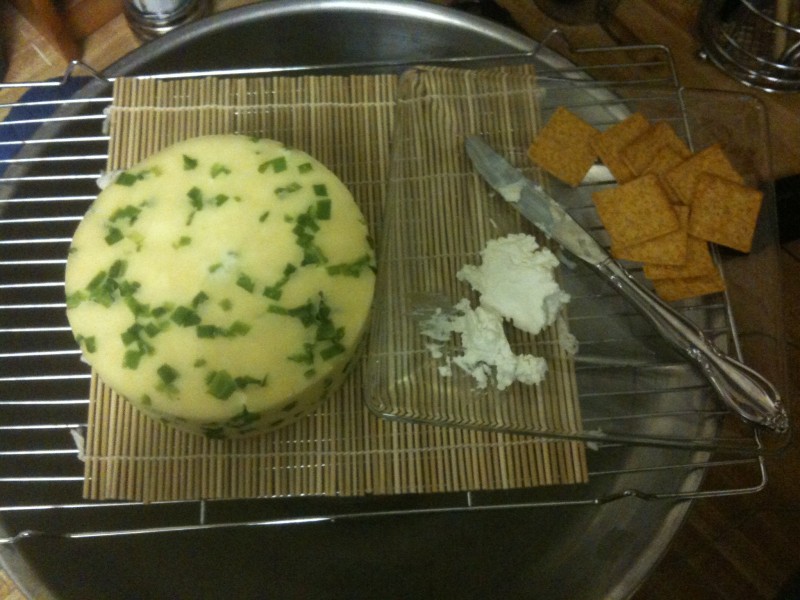
(I know the bowl, cooling rack and other implements make for an odd picture but I was cooking dinner in my rather cramped kitchen while munching on cheese and crackers and I belatedly thought to make a picture with both cheeses!)

P.S. The weekend prior, the CheeseWife™ and I went to a concert in Dallas but first stopped in to Scardello Cheese for wine and cheese.   Scardello’s was a lot better than the concert.  We are glad we stopped by Scardello’s and will definitely make a habit of dropping in whenever we are in Big D. 

Jun. 2011 23

Farmhouse Cheddar

Here is a picture of the “Farmhouse” Cheddar that I started last weekend.

picture: farmhouse cheddar cheese Normally Cheddar cheese goes through a particular process after the curds are set and cut to expel some of the whey.  If you make a cheese like cheddar but omit the “cheddaring” process, it is called Farmhouse Cheddar.  The cheddaring process follows.

First you will drain the curds and then allow them to knit together into a single mass curd, then you cut the mass into slices and stack the slices on top of each other to gently press out some whey, and keep the stacks warm.  I usually keep the colander with cheesecloth over the pot holding the hot whey.  Every so often for some hours you re-stack the slices to press out the same amount of whey from all of the slices.  When this is complete you mill the slices into smaller curds and salt them before putting them into a press.

I skipped that rather long step: I just salted the curds and then put them into the press to press out whey overnight.   This should result in cheddar-tasting cheese that has a different texture.

This one is air-drying to form a fairly dry rind prior to being waxed.

(P.S. I am sorry about the garage-blogging.  It is a long project that will crowd out some of my spare time that I normally use to make cheese.  I need to finish it soon though, as the American Cheese Society meeting in Montreal is in early August.  I will be there!)

Jun. 2011 19

Weekend Update

The work on clearing out my garage is proceeding nicely.  Yesterday I cleared out 10 large trash bags of junk and 4 large boxes of VHS tapes.   I plan to donate the real movies to Goodwill and need to see if there is a way to recycle the plastic for the home-recorded stuff.  I moved two shelving units to the sides of the garage and emptied some book boxes into the shelves. I think it hit 101 degrees here yesterday so I kept a huge pitcher of cold water in the garage with me and managed to drink the whole thing.  I likely have at least three more sessions of work like this before we can get the CheeseWife™‘s car into the garage but the progress so far is satisfying.

Today I treated myself by driving to Burgundy Pasture Beef to pick up some local grassfed beef and chicken, then picked up six gallons of raw milk at All-Natchur_L Farm just a few miles north of Burgundy Pasture Beef’s store.  The next treat was having some Burgundy Pasture steak for lunch with some Kale and Quinoa Salad and some sweet and sour red cabbage while listening to Jane Monheit (Taking a Chance on Love CD).

On to the cheese!  I have three gallons of All-Natchur_L raw milk setting right now preparing for the rennet stage.  According to Frank Kosikowski there are eight stages in making cheese.  The Cheese Mongers Weblog has a nice description of the stages here.  The cheese I am making today is Cheddar.  I am using three packages of mesophillic bacteria from New England Cheesemaking Supply.  I will add a very small portion of vegetable rennet and a few drops of annatto coloring.  I use just enough of the coloring to get a light creamy hue to the cheese rather than enough for an orange hue.   I should be able to post a picture of the cheese curds and the newly pressed cheese tomorrow.

Update 6/20/2011:  Tried to do too much this weekend.  After cleaning garage, then zipping around shopping, replacing a bathroom drain pipe and then cooking a quick pick-up dinner of pasta and some bottled sauce I flat ran out of energy.  I had nothing left when it was time to cheddar the cheese, so I mixed some salt into the curds and put them into the cheese press.  Then I limped to bed.  Tonight I will have a look and see if the cheese will turn into anything worth aging.

Apr. 2011 16

Cheddar

I cut into the Cheddar from the All-Natur_L milk and was pleased with the results:

picture: cheddar

Sorry about the really old cutting board.  My nice new one had some chopped veggies for dinner on it at the time.

For this cheese I used 3 gallons of All-Natur_L raw milk and slightly less than 1/8 teaspoon of double-strength microbial rennet.   I filled the 1/8 teaspoon measure, and then poured two drops back into the bottle.   Even so, it appears that I can cut back on the rennet a little more for the next cheese.

Tasting notes:

  • The cheese is a little firm but is not at all crumbly.   This is a big improvement in texture from my last cheddar.  The cheese was squidgy, by which I mean that as my teeth sank into it I could hear it squeak faintly.  Neither the recent Edam nor Gruyere had that particular texture.
  • This cheddar is a bit too mild in flavor, though the taste is clearly cheddar.  It could probably stand to age quite a bit.
  • I liked the salt amount, which was about 2 and 2/3 tablespoons of sea salt for the 3 gallons of milk.  I had been using 3 tablespoons, but some of my friends had said that the cheeses had been too salty.  The CheeseWife™ thought this one could use more salt, but she has admitted to being a little too fond of salt.  I will eagerly note other taster’s comments on the salt balance.
  • I put a few slices on Triscuit crackers and briefly microwaved them.  This cheese actually melted some.  My prior cheeses would only soften a little.  I attribute this to getting closer to the right amount of rennet.  The melted cheese was more bold flavored.  I can’t wait to try this on a hamburger!
  • There were some holes in the cheese that I attribute to needing to mill the curds finer before pressing.  I do not have a cheese mill, so I use a knife and cutting board.
  • There was a little fluid weeping from the cheese when I first cut it.  This looks like extra whey that I should have expelled before waxing the cheese.   Real cheesemakers have a drying area and age their cheeses longer.

Yes I am making real cheese, but I still consider myself a newbie at this hobby.   I understand that professional cheesemakers are only eligible to attempt to be certified as a master cheesemaker for a particular type of cheese after they have been making that cheese for more than 10 years.  Cheese longa, vita brevis!

Apr. 2011 8

Edam

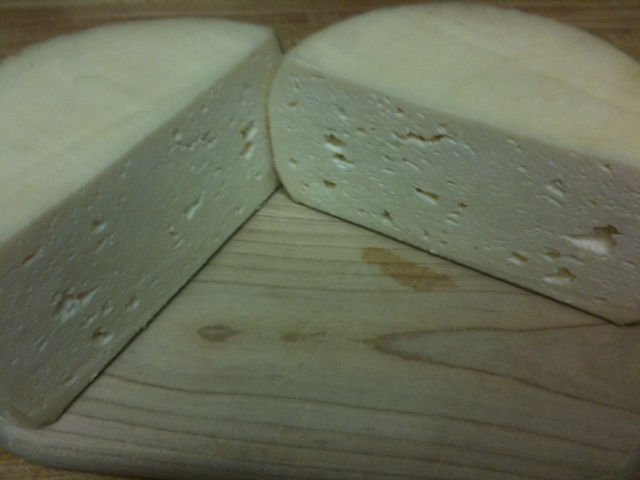
Yesterday I cut into the Edam and was startled at how many holes there were:

picture: Edam cheese

I just looked up some information on the Flora Danica bacteria culture that I used and indeed it produces a fair amount of carbon dioxide.  Flora Danica (literally flower of Denmark) is commonly used in Danish cheeses such as Havarti, Gouda and Edam.

Tasting notes:

  • There is some tartness from the bacterial culture.  It is not the same as the tartness of cheddar.  It seems to be tart but also carry a hint of butter to the flavor.
  • Aside from the slight tartness, the flavor is quite mild.
  • The cheese is a little firmer than I expected but produces nice clean slices when I cut it.  I seem to have gotten past my problem with producing cheese that is too crumbly.

This milk for this cheese was from All-Natur_L farm near Alvarado and Cleburne.  I will probably concentrate my efforts on raw milk from here on out.  The quality and flavor of raw milk is remarkable and that is a quality I want in the home made cheeses I produce.

I still have a cheddar from All-Natur_L milk aging.  I will wait a couple more weeks before cutting that one.

Tomorrow I plan to buy several gallons of raw milk for more cheeses.  A friend has asked me to make him some Gouda and I want to make an Emmenthaler.  I guess I’ll have to make both!